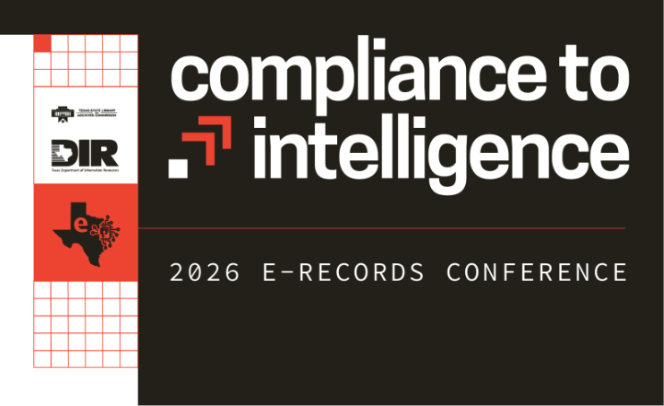
Two professionals from The University of Texas at Austin will share complementary perspectives on the changing information landscape at e-Records 2026 on November 20, 2026. Elista Street of Enterprise Technology (ET) and Jenny Alexander, Director of Records and Information Management Services (RIMS), will explore different sides of a challenge that increasingly connects their work: how organizations can better manage growing volumes of digital information.
Street will examine how the University's Microsoft Copilot rollout brought new attention to outdated, duplicate, and unnecessary information, while Alexander will share RIMS's roadmap for strengthening records and information management compliance through relationships, training, inventory, and monitoring.
Their presentations also reflect a broader partnership between RIMS and ET. RIMS brings records management expertise and policy leadership, while ET provides technology platforms, support, and integrations that help put those practices into action. Together, the teams connect information management principles with the technologies and workflows University employees use every day.
Two Perspectives on a Changing Information Landscape
Organized by the Texas State Library and Archives Commission and co-sponsored by the Texas Department of Information Resources, e-Records brings together records management, information technology, legal, data, and other professionals to share case studies, lessons learned, and approaches to electronic records management.
This year's theme, Compliance to Intelligence, reflects the growing connections among records management, data governance, cybersecurity, privacy, and artificial intelligence.
Street and Alexander will approach those connections from different directions: one through the impact of emerging technology on everyday information practices and the other through the relationships, processes, and oversight needed to build a strong records and information management program.
Copilot as a Catalyst for Better Information Practices
In the morning's People & Program Maturity track, Elista Street of Enterprise Technology will present "How to Get People to Give a ROT: What Happened When UT Austin Rolled Out Copilot."
The session examines how the University's Microsoft Copilot rollout created an unexpected opportunity for information governance and records management. As AI began surfacing content from across SharePoint, OneDrive, and other Microsoft 365 services, employees became more aware of outdated files, duplicate content, forgotten workspaces, and excessive sharing permissions. What had long been viewed as a records management challenge quickly became an everyday business concern.
Drawing on her experience supporting the University's Microsoft Copilot rollout, Street will explore how AI brought new attention to redundant, obsolete, and trivial (ROT) information and helped create momentum for digital cleanup and better information management practices across the organization.
Building Beyond Compliance
Later in the day, Jenny Alexander, Director of Records and Information Management Services, will deliver the featured general session "4 Pillars to Compliance: Building Beyond the Policy Foundation."
Drawing on her experience leading records and information management efforts at the University, Alexander will share the University's current roadmap for raising the bar on records and information management compliance. The RIMS roadmap takes a holistic approach centered on four key areas of development: relationships, training, inventory, and monitoring.
Her presentation will close a day of discussions and provide a records management perspective on many of the same challenges raised throughout the conference: how organizations can move beyond individual policies and requirements to build sustainable practices for managing information over time.
Connecting Information Management and Technology
RIMS and ET work together to connect records management requirements with the technologies University employees use to create, share, store, and manage information.
RIMS provides records management expertise and policies that guide document management and storage, while ET provides technology platforms, support, and integrations that help put those practices into action. ET also engages RIMS when proposed technology changes could affect how University information is stored and managed.
That collaboration has supported transitions from legacy storage platforms to SharePoint and expanded DocuSign-enabled workflows that reduce manual document handling and strengthen records practices. As technologies such as artificial intelligence change how people find and use information, the connection between technology and information management is becoming increasingly important.
Street and Alexander's presentations at e-Records 2026 bring those complementary perspectives to a broader conversation. Together, they demonstrate how technology and records management can inform one another as organizations adapt to a more complex digital information environment.
About e-Records 2026
e-Records 2026 is organized by the Texas State Library and Archives Commission and co-sponsored by the Texas Department of Information Resources. The conference brings together records management and information technology professionals from state and local government to share case studies, solutions, practices, challenges, and lessons learned.
This year's theme, Compliance to Intelligence, focuses on the evolving relationships among records management, data governance, cybersecurity, privacy, and artificial intelligence.
Registration Details
Registration for e-Records 2026 is open to Texas public-sector employees, including University employees. The conference will be held November 20, 2026, with early-bird registration available for $95 through November 6.